Every strong landscape in Los Angeles starts with water management. The city’s Mediterranean climate lulls many homeowners into thinking drainage is an afterthought. It is not. A single Pacific storm cell can drop a month’s rainfall in hours, then nothing for weeks. Properties on slopes shed water quickly; valley floors trap it. Clay-heavy pockets across the Basin hold moisture stubbornly. If you do not plan for the surge and the stall, patios heave, lawns sour, retaining walls bow, and neighbors complain.
Ridgeline Outdoor Living approaches drainage as infrastructure, not a bandage. We strategize at the master-plan level, then execute the details that make the difference between a dry, resilient yard and an expensive source of headaches. The solutions look simple when they are done right: a lawn that never puddles, a driveway that stays clear, a hillside that does not slide. Under the surface sits design, math, and careful construction.
What drives yard flooding in Southern California
Stormwater problems in this region come from a combination of intense but sporadic rainfall, mixed soils, and dense development. Roofs, driveways, and pool decks add impervious area that concentrates runoff. Downspouts often dump water at the base of walls. Compact clay lenses reduce percolation. On older homes, the finish grade sometimes slopes back toward the foundation. On hillsides, subsurface water follows seams and daylight points you would not predict without investigation. Add irrigation overspray on a timer and a few leaky valves, and a small drainage defect becomes chronic.
In our field notes from the last decade, certain patterns repeat. A wide lot in Sherman Oaks with a flat backyard flooded not because of the storm itself, but because the 6 inch curb opening at the street had silted shut. A modern house in the Hollywood Hills saw pavers sink because bedding sand migrated into an unlined French drain, turning the trench into a vacuum for fines. A Brentwood property struggled with a mildewed fence line where the neighbor’s lot sat 18 inches higher, and there was no swale to collect cross-lot sheet flow. Each of these was predictable and preventable once you understand how water seeks the path of least resistance.
How we diagnose: from elevations to infiltration
The first site visit is part detective work, part survey. We start with the obvious water paths and end at the unseen ones. Painting a big picture prevents you from spending money in the wrong place.
We walk the property during or right after a storm whenever possible. Failing that, we look for telltales: sediment fans, algae on hardscape, crusted lawn edges, weep holes with stains, fence posts with rot at a consistent height, and efflorescence on masonry. We then map elevations with a laser level to understand fall from the back of the lot to the street and from hardscape to the house threshold. A half inch per foot of slope is a good target for surface drainage on turf or mulch, less on finished hardscape if trip hazards are a concern.
Under the surface, soils drive everything. Sandy soils take water quickly but dry fast; clay resists intake, then stays wet for days. We run a simple infiltration test by augering a 6 to 8 inch diameter hole, saturating local landscapers in Pasadena it, and then tracking drop rate over an hour. That rate informs whether a dry well, infiltration gallery, or a line out to the curb makes sense. Where we suspect perched groundwater or springs, we add observation wells for a week. Utilities must be marked. Los Angeles homes often have shallow irrigation laterals, unrecorded drain lines, or old clay sewer laterals at risk during trenching.
When drainage needs tie into hardscape changes, we layer in the build plan. Paver patios vs stamped concrete behave differently. Permeable pavers let us move water through the joints into a graded base and out to storage or daylight. Stamped concrete is monolithic; it demands precise surface slope and dedicated area drains. In a city where homeowners love modern patios, the decision affects both aesthetics and hydrology. Many clients land on paver systems after seeing 15 Paver Patio Designs Los Angeles Homeowners Love, not only for looks, but for the way they ease stormwater loads without compromising style.
Five signs your yard needs professional drainage help
- Water stands on the lawn or hardscape longer than 24 to 48 hours after rain. Downspouts discharge near the foundation and leave damp interior walls or musty smells. Mulch migrates during storms, accumulating at low points or against fences. Pavers settle or pump water when stepped on, and fine sand appears in drain grates. Hillside planting beds slump or show tension cracks, even where irrigation seems modest.
Proven solutions we use, and when we reach for each
Most properties need a blend of methods, sized and tuned to the site. The wrong application, even if well built, can move the problem or create a new one. We prioritize gravity first, storage second, and mechanical systems only where necessary.
Business Name: Ridgeline Outdoor Living
Address: 845 E Walnut St, Pasadena, CA 91101, United States
Phone: (626) 469-5822
Ridgeline Outdoor Living
Ridgeline Outdoor Living is a Pasadena-based landscape design-build company serving Greater Los Angeles with custom outdoor living, hardscape, and drought-tolerant landscape solutions. The company specializes in patios, retaining walls, outdoor kitchens, drainage, hillside projects, and turnkey landscape construction, handling projects from design and permitting through final build and warranty.
845 E Walnut St, Pasadena, CA 91101, USA
Business Hours:
- Monday – Saturday: 8:00 AM – 6:00 PM
- Sunday: Closed
Follow Us:
Shaping the surface with grading and swales. Often, the fastest win is correcting grade. We lower high spots and create subtle swales to shepherd water along the edges of use areas, not through the middle of them. A grass swale looks like part of landscaping guides the lawn; a cobble swale becomes a design feature. Slopes as low as one percent work if the swale is continuous and free of obstructions. On shared property lines, we confirm grades do not push water onto a neighbor, both for courtesy and to comply with local nuisance water ordinances.
French drains explained, and used correctly. A French drain is a perforated pipe in a gravel trench that intercepts subsurface flow. The pipe lives inside washed rock, wrapped in a nonwoven geotextile to keep fines out. We use them parallel to slopes to cut off water before it reaches patios or footings, along the toe of retaining walls to relieve hydrostatic pressure, and under softscape where a perched clay layer traps moisture near the surface. The biggest errors we see: trenches too shallow, the wrong fabric, insufficient gravel depth, and no cleanouts. French Drains Explained: Protecting Your Property From Water Damage sounds simple; getting the details right is the difference between a twenty-year fix and a three-year headache.
Area drains, catch basins, and curb cores. Where roof leaders and large paving surfaces concentrate flow, surface inlets matter. We select basins with sumps that trap sediment, and we set them at low points tied together with smooth-walled SDR-35 or Schedule 40 PVC for durability. The outlet may be to a curb core at the street, which in Los Angeles requires a permit and a specific opening geometry. If the lot sits below street grade, we plan for storage or pumping.
Dry wells and infiltration galleries. In neighborhoods where discharging to the street is discouraged or infeasible, we store and infiltrate on site. A dry well is a vertical pit filled with stone or a manufactured chamber. A gallery is a longer, shallow system. Their feasibility turns on infiltration rate and seasonal groundwater. We run the math based on roof area and design storm depth to size capacity. Maintenance access is not optional. A clogged conveyance pipe that feeds a buried gallery defeats the whole system.
Permeable hardscapes and smarter patios. Paver patios are an opportunity to manage water while elevating outdoor living. A permeable system uses wider joints, an open-graded stone base, and underdrains to move water away slowly. It is a strong answer for courtyards and driveways, especially when paired with 15 Driveway Paving Ideas to Improve Curb Appeal. If clients prefer the look of monolithic surfaces, we discuss Paver Patios vs Stamped Concrete: Pros and Cons in practical terms. Stamped concrete is less forgiving. It needs crisp cross-slope to sheds water, more control joints, and nearby area drains. In both cases, we avoid trapping water at the house with a discrete one inch drop from threshold to paving and a positive slope away.

Downspout management and storage. A surprising amount of yard flooding starts with roof water allowed to roam. We hard-pipe leaders to basins, galleries, or cisterns sized to the roof planes that feed them. On larger custom homes, cisterns turn nuisance into supply for irrigation under non-storm periods. When clients ask How Much Does an Outdoor Kitchen Cost in Los Angeles?, we remind them that tying roof leaders under that future kitchen is cheaper before the slab is poured than after.
Hillside retaining walls with engineered drainage. On slopes, hydrostatic pressure ruins walls, even those with thick blocks. We specify weep holes, continuous perforated drains at the heel, free-draining backfill wrapped in fabric, and an outlet that cannot clog. Retaining Walls for Hillside Properties: What Homeowners Need to Know always includes drainage design and observation. On long walls, we break the system into sections so a blockage cannot take down the whole run.
Bioswales, rain gardens, and drought-tolerant planting. Drought-tolerant landscaping shines when it does double duty. A shallow rain garden receives downspout water, holds it briefly, then infiltrates what it can. The plant palette matters. The Best Drought-Tolerant Plants for Los Angeles Yards include species that handle episodic wet feet, like Juncus patens and Muhlenbergia rigens, alongside Arctostaphylos and Ceanothus on the berms. Pairing these ideas with 15 Water-Wise Landscaping Ideas for California Homes keeps the design coherent and water-wise.
Sump pumps and controlled discharge. When gravity refuses to cooperate, we install a basin with a submersible pump and check valve to lift water to a legal discharge point. We choose cast-iron or stainless housings, float switches you can replace, and a dedicated GFCI-protected circuit. Pumps require commitment to maintenance and power; we use them sparingly and make sure homeowners understand the trade-offs.
Pool decks, kitchens, and entertainment zones. Many of the features clients love, from 12 Backyard Fire Pit Ideas for Entertaining Year-Round to Outdoor Kitchen Trends Los Angeles Homeowners Are Choosing, occupy the best real estate on a lot. We run stormwater under and around these spaces so they perform year-round. For outdoor kitchens, floor drains under grills and ice makers prevent nuisance water from spilling across the patio. For pools, we separate deck drains from backwash systems so they do not overload one another. When designing 12 Backyard Entertainment Features Every Homeowner Should Consider, discreet slot drains can keep lines clean without visual clutter.
Lighting and electricity in wet zones. 10 Outdoor Lighting Ideas for Los Angeles Landscapes often involve fixtures near grade. We elevate junction boxes, seal conduit entries, and ensure drain lines do not pass under light standards where settling could create low points and wire strain. It is not dramatic, but it protects against nuisance trips and corrosion.
Three project snapshots that show the range
A coastal clay backyard that would not dry. A lot in Mar Vista had a generous lawn that stayed spongey from November to March, then baked in June. The infiltration rate was under a quarter inch per hour. We established a shallow swale along the fence line, cut a French drain across the up-slope property edge to intercept subsurface flow, and directed roof leaders to a 600 gallon modular gallery. The lawn surface was regraded with a one percent fall to the swale, and turf was replaced with a hybrid of artificial turf and drought-tolerant beds after a candid talk about Artificial Turf vs Sod: What’s Best for Los Angeles Homes? By the next storm cycle, puddling disappeared. Water in the gallery percolated within 36 hours post-storm.
A hillside patio that moved, slightly, every winter. In Silver Lake, a sleek paver terrace crept a few millimeters each winter, cracking grout at the house. Investigation showed bedding sand migrating into an unwrapped trench drain. We rebuilt the edge restraint, swapped to an open-graded base with a geotextile separator, and added a cutoff drain at the upslope planting bed. Cleanouts at each bend made annual maintenance simple. The terrace stopped moving. The owner later commissioned 10 Outdoor Living Ideas Transforming Los Angeles Backyards for inspiration on a second phase and kept the permeable approach throughout.
A driveway where the street sat higher than the garage. In Encino, the street crowned above the slab elevation. The existing trench drain at the garage door handled normal flows but failed in intense storms. The fix combined a deeper, wider trench drain with a secondary sump on a float switch that lifted water to a new curb core. The electrical was placed behind a dedicated GFCI in the garage, the discharge line included a union for service, and a high-water alarm texted the owner during an atmospheric river event. The garage stayed dry, and the system has run two seasons with only routine cleaning.
Protecting value across the rest of the landscape
Good drainage quietly supports every investment you make outdoors. Ten Hardscaping Features That Increase Property Value often start with a stable base. When we design How Ridgeline Outdoor Living Creates Functional Outdoor Living Spaces, water never gets the final say on layout. That seating wall you love does not trap sheet flow. The pergola posts do not sit in a seasonal puddle. The BBQ island does not settle a half inch and tip a counter.
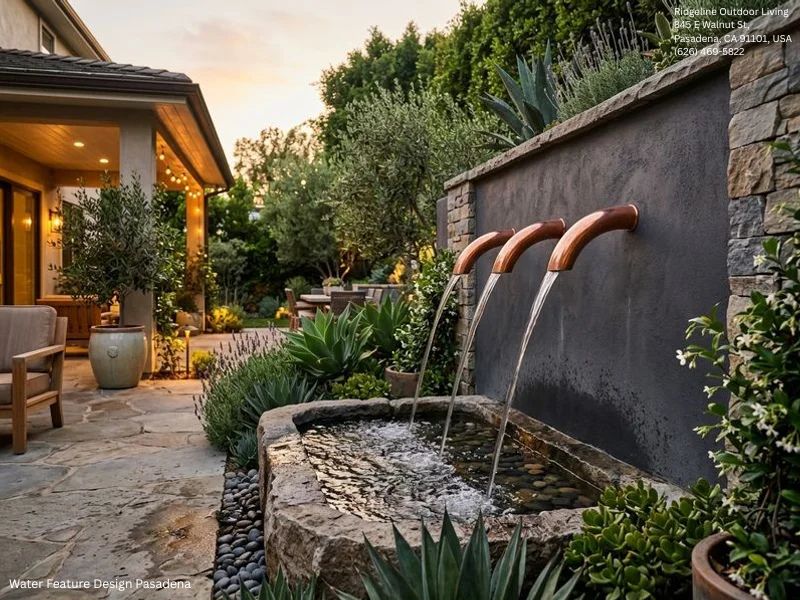
Where clients dream of 10 Ways to Create a Resort-Style Backyard at Home, we find elegant ways to integrate stormwater features into the aesthetic. A basalt water rill doubles as a conveyance path during storms. A low, stone-lined swale reads as a garden path 90 percent of the year. In a city that prizes minimalism, the best drainage is often invisible. When it cannot be, we make it handsome.
Permits, code, and neighbor relations
Los Angeles and many local municipalities regulate connections to the public right of way and manage stormwater via municipal separate storm sewer system permits. Creating or enlarging a curb core requires a permit. Discharging concentrated flow onto a sidewalk invites both fines and friction. On private property, nuisance water rules prevent you from moving your problem to the next lot. If we suspect our design will change how water crosses a property line, we discuss it with neighbors before mobilizing.
Call 811 before digging is not optional. Even shallow trenches can find old gas, water, or telecom lines. We photograph and map any buried drains for homeowners’ records, and we install cleanout risers at grade that do not trip you during a garden party.
Cost thinking without the guesswork
Homeowners often ask for exact pricing up front. Costs vary with access, soil, length of runs, depth, structures to cross, and restoration. A short run of area drains tied to a curb can be a relatively modest line item if we trench through mulch and restore lawn. A long French drain, tied to a gallery under a driveway with beautiful finishes to protect, can reach into a serious investment. We advise setting a contingency when drainage is married to major upgrades like outdoor kitchens or pool decks. Moving a drain pipe after a footing is poured is never cheap. If your broader project includes 10 Backyard Upgrades Worth the Investment, place drainage early in the budget, not at the end.
Maintenance that keeps systems working for decades
Even perfectly built drainage needs light care. Yard debris, roof grit, and roots are persistent. We design for serviceability with cleanouts every 50 to 75 feet and at each change of direction. Basins with sumps catch sediment before it enters buried lines.
Here is a simple seasonal routine we coach clients to follow.
- After the first heavy fall storm, open catch basin grates and empty the sumps. Check that water stands no higher than the invert of the outlet. Flush downspouts with a hose from the roof and confirm strong outflow at the nearest accessible outlet or cleanout. Inspect swales and cobble bands for settled spots and silt crusts; rake level and top up cobble where needed. Test any sump pump by lifting the float; listen for smooth operation and examine the discharge point for strong flow. In late spring, run water through French drains via cleanouts for a minute to confirm there are no blockages, then cap securely.
Professional service every few years helps. We hydrojet lines that show slow drains, snake roots that find perforations, and replace aging grates with updated, heel-proof models. The cost is minimal compared to the damage from a single overwhelmed system.
Avoiding the pitfalls we see most often
There are the classics, and we intercept them early in design. Setting patio grades level to chase a minimalist look fails when it rains; we compromise with slight cross-slope that the eye does not catch but the water does. Terminating a French drain in a flat backyard with nowhere to daylight sets you up for a flooded trench. Planting thirstier species in a bioswale that will sit wet then dry stresses them, so we pick plants that tolerate variability. Using unwashed pea gravel invites silt. Laying filter fabric under paver bedding sand creates a slip plane and future settlement; we put fabric between soils and base, not under the paver layer.
We also talk clients out of overbuilding. A massive gallery under a small roof in fast-draining soil is not a better solution than a modest one. On a tight budget, regrading paired with thoughtful downspout piping often solves 70 percent of the issue. Save pumps for lots that cannot move water by gravity.
How drainage folds into the rest of your project
If you are planning a larger build, from Pergolas vs Covered Patios: Which Is Right for Your Home? To Pool Landscaping Ideas for Los Angeles Homes, bring drainage choices into the early sketches. Conduit runs, gas lines, and footings fight with late-stage drains. We coordinate trades so trenches for lighting or audio double as runs for low-point relief. In a design-build approach, discussed in How Ridgeline Outdoor Living Approaches Design-Build Landscaping, one team owns the sequencing and the details that prevent rework. The result saves both time and money. Why Professional Landscape Design Saves Time and Money is never more obvious than when the first storm hits a new project and everything drains the way we planned.
When to call us
If water lingers longer than two days, if you are seeing cracks or settlement near hardscape, or if your hillside plantings sag after storms, it is time for a thorough look. We start with a site assessment and a clear scope, then lay out options with trade-offs. Not every yard needs the most complex solution. Many need the right simple one, installed well.
Ridgeline Outdoor Living designs drainage systems to be as invisible as possible and as dependable as necessary. The goal is not just a dry yard, but a landscape that performs. Whether your project centers on 12 Water Feature Ideas for Luxury Los Angeles Backyards, Designing the Perfect Outdoor Dining Space, or 15 Luxury Hardscape Ideas for Southern California Homes, we build the storm plan into the beauty. When the rain comes, you will not be thinking about pipes and slopes. You will be watching the water move exactly where it should, then disappear.