Southern California yards have a short memory. Months of sun convince homeowners everything is fine, then a single Pacific storm drops more than an inch in a day and the property’s weak spots show themselves. At Ridgeline Outdoor Living, we design and build landscapes that look good every day of the year, not just when the weather cooperates. That starts with drainage. Good drainage guards foundations, protects hardscapes, helps plants thrive, and keeps outdoor living spaces usable after rain. Poor drainage does the opposite, often quietly, until it becomes expensive.
What follows are ten red flags our team watches for during on-site assessments across Los Angeles, from hillside lots in the Hollywood Hills to flat parcels in the Valley. Along the way, you will see how we test, what we ask, and which solutions work in our climate and soils. We will also point you to allied topics like French drains, retaining walls, and drought-tolerant design, because in a well planned landscape each system supports the next.
Why Los Angeles yards fail at drainage
Two conditions set our region apart. First, soils are varied, with pockets of clay that percolate slowly and decomposed granite that sheds water quickly. Second, storms come in bursts. Dry months harden the surface, then a winter front dumps a fast inch or more. Water either does not soak in at all or it soaks in unevenly, finding joints, seams, and low spots. Combine that with tight side yards, additions that altered grading, and older homes built before modern stormwater standards, and you have a recipe for pooling, erosion, and basement moisture.

Hardscapes complicate the picture. Paver patios, driveways, and pool decks can move water beautifully when set up with proper slopes, permeable joints, and drains. They can also funnel water right at your foundation if they are even a quarter inch low in the wrong place. The same goes for artificial turf, compacted decomposed granite walkways, and decorative river rock. Every surface choice has a hydrologic footprint.
Red flag 1: Water pooling within 10 feet of the foundation
Any standing water within a few paces of the house deserves attention. We see this most often beneath downspouts that simply dump onto soil or hardscape. Even twenty minutes of sheet flow in a heavy rain can drive moisture through hairline cracks or weep joints. If you added a room, changed the grade, or replaced a patio, the original drainage plan may no longer work.
During an assessment, we check downspout discharge and measure slope away from the foundation. For slab homes, a minimum fall of 2 percent over the first 5 to 10 feet is a practical target. If the grade is fixed, a tight catch basin connected to solid pipe can carry roof water to a safe outlet. On tight urban lots, a small dry well or an under-patio infiltration trench can store a storm’s first half inch.
Red flag 2: Mulch or soil displaced after rain
Shredded bark piled against a slope should stay put in a normal storm. If you find mulch matted at the bottom of a bed, your slope is shedding water faster than it infiltrates. On clay slopes, we often see miniature rills cut into the surface. That erosion signals two problems: your planting scheme is not slowing water, and your hardscapes may soon face undermining along edges.
We evaluate surface roughness and plant coverage. Tighter spacing with drought-tolerant groundcovers, terraced planting pockets, and small rock check dams break velocity and reduce soil movement. Where paths or stairs cut across slopes, we add stabilized joints or grated trench drains at the uphill edge to intercept sheet flow. These are small changes that carry outsized protection, and they pair well with hillside landscaping strategies many Los Angeles homeowners already consider for fire and erosion control.
Red flag 3: Efflorescence or spalling on retaining walls
A white, powdery bloom on masonry tells a story. Water is getting into the wall, dissolving salts, and exiting through the face. If left unaddressed, that moisture pressure can crack block cores, pop capstones, and stain finishes. With hillside properties, hydrostatic pressure is the real threat. Dirt holds water, water holds weight, and weight pushes on the wall.
We check every wall for weep holes, perforated drain lines behind the wall, and breathable backfill like clean gravel. Older walls often lack even one of these. Retrofitting a drain behind a short wall is straightforward if access allows, but tall engineered walls require careful design and sometimes partial reconstruction. For new construction, we insist on back-drains, geogrid where required, and fabric separation between soil and gravel so the system does not clog. If you are assessing wall options, our guide on retaining walls for hillside properties outlines when to choose modular block, poured concrete, or reinforced systems.
Red flag 4: Heaving or settlement in pavers and concrete
A patio that looks wavy after rain likely has subgrade issues. Saturated base material loses strength and migrates, which telegraphs as dips and ridges. In paver systems, joints widen where the base settles and sand washes out. In monolithic concrete, settled corners crack at stress points.
We pull a few edge pavers to inspect the base. If fines have moved, we trace the water path that allowed it. Sometimes the fix is as simple as adding a channel drain at a threshold to stop water from running under the surface. Other times, we rebuild a section with open-graded base rock and a thicker bedding layer. Permeable paver patios, popular in some of the 15 paver patio designs Los Angeles homeowners love, can be an excellent choice if the site and soils are suitable. They store and meter water, but only if the whole assembly is engineered for local storm intensity.
Red flag 5: Soggy turf long after a storm passes
Lawns that stay wet a day or more after rain are not just unpleasant to walk on. They suffocate roots, foster fungal disease, and invite thatch buildup. In Los Angeles, many older lawn areas were graded flat for irrigation efficiency. That makes for even coverage, but it gives water no place to go.
We probe the soil to see the percolation rate, then decide whether to regrade, install subsurface drains, or both. French drains, explained in detail in our drainage primer, are a staple under overwatered turf and at the toe of ornamental slopes. Where clients choose artificial turf instead, we specify a free-draining base and verify edge containment so fines do not migrate onto adjacent hardscapes. If you are weighing artificial turf vs sod, drainage performance, heat, and maintenance all factor into the decision.
Red flag 6: Downspouts tied to nowhere
We routinely find buried pipes that end under a deck or vanish into compacted soil. Builders installed these stubs to get water away from the eave, then never provided an outlet. The result is hidden saturation that telegraphs as musty crawlspaces, popping deck boards, or that familiar efflorescence line on a stem wall.
Our crew uses a hose and camera where needed to map these runs. The remedy is to extend the system with solid pipe to an approved discharge point, whether that is a curb core, a dry well with overflow, or a daylight outlet on a lower part of the property. In cities that require on-site retention of the first flush, we size infiltration trenches based on roof area and soil infiltration tests. We prefer to hide storage under a paver driveway or side yard where maintenance access is easy.
Red flag 7: Water running through the neighbor’s yard
Side yards in Los Angeles are narrow, and grade often falls from one property to the next. A simple fence change can redirect water. So can a new driveway or raised planter. If you see flow lines crossing property lines or if your neighbor mentions puddles after your remodel, act quickly. Water disputes escalate fast, and most jurisdictions hold each owner responsible for managing runoff on their own parcel.
We look at existing swales, fence footings, and the high points that control flow. In many cases, a shallow swale, shaped and lined with decorative cobble, can carry water along the property line without trespassing. Where space is tight, a grated trench drain along a boundary path provides a clean solution. Good drainage is neighborly design, and it protects your investment in outdoor living areas like kitchens, fire pits, and pergolas that rely on dry, stable ground.
Red flag 8: Stains and slip hazards on steps and landings
Dark algae stains on shady steps tell us water lingers there. That is a safety issue and an indicator of undersized or missing drains. We see it under hose bibs, along the down-slope edge of covered patios, and at the base of sloped driveways where runoff collects.
Our fix starts with slope. Even a quarter inch per foot matters on tile or smooth concrete. Next, we choose the right drain type. Grated trench drains excel at collecting sheet flow across an entire width. Small round basins work in corners or beneath scuppers. Every drain needs three things to perform over time: a debris basket you can lift with one hand, a pipe sized for local storm intensity, and a place to inspect the outlet. Design them well and they disappear visually, while keeping surfaces clean and safe.
Red flag 9: Irrigation cycling runoff onto sidewalks and streets
If your sprinklers push water over the curb five minutes into a cycle, your system is applying more than your soil can accept. Runoff not only wastes water, it lifts fines from beds and carries them to drains that later clog during storms. Over time, that habit creates compaction and water-repellent soils at the surface.
We audit zones, adjust heads, and use cycle-and-soak programming so water has time to infiltrate. In renovation projects, we often replace spray heads with drip in shrub beds, which reduces runoff and makes storm drainage easier to manage. Drought-tolerant landscaping does not mean dry. It means thoughtful watering on soils prepared with compost where appropriate, and it pays off with healthier plants and less erosion when the rains return.
Red flag 10: Seasonal musty odor indoors without visible leaks
Moisture problems do not always show outside. A faint musty smell in a lower level, especially after a storm, points to vapor moving through the slab or walls. Window wells and below-grade doors can also serve as unintentional basins during downpours.
We inspect thresholds, check grades at egress wells, and look for perimeter drains that might be overwhelmed. Sump pumps are rare in Los Angeles single-family homes, but we install them where below-grade spaces have no gravity outlet. The key is redundancy. If a pump is necessary, pair it with a battery backup, keep debris screens accessible, and design the discharge line so it does not recycle back toward the foundation.
How we assess drainage on site
A good drainage plan comes from fieldwork. Here is how our team typically proceeds during a site visit, whether we are designing a new outdoor kitchen, a paver patio, or a hillside garden that needs erosion control.
- Walk the property in two passes, first with homeowner input, then independently to catch what daily familiarity might hide. Map grades with a builder’s level or laser, noting high and low points, threshold elevations, and wall heights. Flood test key areas with a hose, starting at downspouts and working out to patios, steps, and side yards to watch flow paths. Open and inspect any existing drains, basins, or pop-up emitters for sediment, root intrusion, and proper connection. Document with photos and sketches, then translate the site reality into a plan that shows slopes, drain locations, and discharge points.
In many cases we can flag quick wins during the visit. Redirecting a downspout, cleaning a clogged basin, or adjusting a threshold can immediately reduce risk while we design larger solutions.
Common fixes that actually work here
Los Angeles has its own toolkit because of our storms, soils, and hills. French drains at the toe of slopes, under soggy lawns, or parallel to driveways that collect lateral flow are landscaping guides dependable. Properly built, a French drain is not a pipe hardscaping contractors Pasadena in dirt. It is an aggregate trench wrapped in fabric with a perforated pipe set low, sloped to an outlet, and protected from fines. Done right, it works for decades.
Grated trench drains belong at the base of sloped driveways that meet a garage, along patio edges where sheet flow hits a step, and at transitions where two hardscape planes meet. Catch basins are ideal under downspouts, at valley gutter dumps, and in planting beds where local low points form. Dry wells and infiltration trenches offer on-site retention where codes require it or where outlets are unavailable. The volume we recommend depends on your roof area and soil infiltration rate, which we test on site. For ballpark sizing, a small single-family roof may need 100 to 300 cubic feet of storage to capture the first significant pulse, but your soil and available footprint will steer the final design.
Retaining walls, terraces, and planting can be drainage solutions too. On long slopes, a series of low terraces slows water and spreads it. Plant palettes drawn from the best drought-tolerant plants for Los Angeles yards often have fibrous roots that stabilize soil and improve infiltration over time. Where a slope meets a patio, a narrow planting strip with a subdrain can intercept and filter runoff before it hits hardscape.
Hardscape selection matters. Permeable pavers can reduce runoff and ease the load on downstream drains if designed as a system. Concrete with broom finishes gives grip on wet days, and slight texture reduces slime growth in shaded areas. When we design paver patios vs stamped concrete, we weigh budget, drainage goals, maintenance comfort, and the look of adjacent materials like pool coping or driveway pavers. There is no single right answer, just better choices for the specific site.
When a redesign pays for itself
We have rebuilt patios that had sunk twice in five years because the base sat in a seasonal pond. The owner had patched joints and added more sand, but the problem was structural and hydrologic. Regrading a narrow swale along the house, adding a discreet trench drain at a threshold, and rebuilding the base with open-graded stone ended the cycle. That project cost more up front than another patch, but it protected interior flooring, preserved furniture, and restored year-round use. Over a decade, that is the cheaper path.
Outdoor living investments depend on drainage. An outdoor kitchen, even a modest one, can cost anywhere from the low tens of thousands into six figures as features pile on. You do not want grill island footings sitting in seasonal water, gas lines undermined by erosion, or appliance cabinets swelling every winter. Designing the perfect outdoor dining space is easier when you start with dry feet and predictable flow paths. The same holds for pergolas vs covered patios. Posts, slabs, and deck boards last longer when water leaves quickly.
A brief pre-visit checklist for homeowners
- Note where water pooled during the last storm, and for how long it remained. Gather any previous drainage or grading plans, even rough sketches from past work. Clear debris from visible basins and pop-up emitters so we can test quickly. Identify utility locations if known, especially gas, electrical, and irrigation valves. Walk the property after running a hose at a downspout for five minutes, and record what you see.
These small steps help us use your site visit efficiently and make better decisions on the spot.
Maintenance keeps systems honest
Even the best drains fail if neglected. Basins fill with leaves, fabric clogs with fines, and roots chase moisture. We design for maintenance with baskets you can lift, cleanouts at pipe runs, and visible outlets. Twice a year is the minimum schedule we recommend, with one check before the rainy season and one after the heaviest storms. When you schedule seasonal service for irrigation or lighting, add drainage to the list. A ten minute inspection can save a driveway from undermining or a wall from pressure cracks.
If you manage a larger property with multiple features, consider bundling services. Our teams often pair drainage checks with tasks from our outdoor lighting guide, such as re-aiming fixtures and cleaning lenses, because trench drains and path lights occupy the same real estate. Efficiency matters in busy households.
Design choices that quietly solve problems
You can reduce drainage risk while elevating your landscape. A driveway that slopes to a central trench with a decorative grate both looks sharp and functions in downpours. A pool deck that sheds water to a vegetated swale keeps splash-out from staining coping. A fire pit set on a slightly raised platform avoids puddling while framing views. Many of the 10 hardscaping features that increase property value do double duty when integrated with drainage.
Business Name: Ridgeline Outdoor Living
Address: 845 E Walnut St, Pasadena, CA 91101, United States
Phone: (626) 469-5822
Ridgeline Outdoor Living
Ridgeline Outdoor Living is a Pasadena-based landscape design-build company serving Greater Los Angeles with custom outdoor living, hardscape, and drought-tolerant landscape solutions. The company specializes in patios, retaining walls, outdoor kitchens, drainage, hillside projects, and turnkey landscape construction, handling projects from design and permitting through final build and warranty.
845 E Walnut St, Pasadena, CA 91101, USA
Business Hours:
- Monday – Saturday: 8:00 AM – 6:00 PM
- Sunday: Closed
Follow Us:
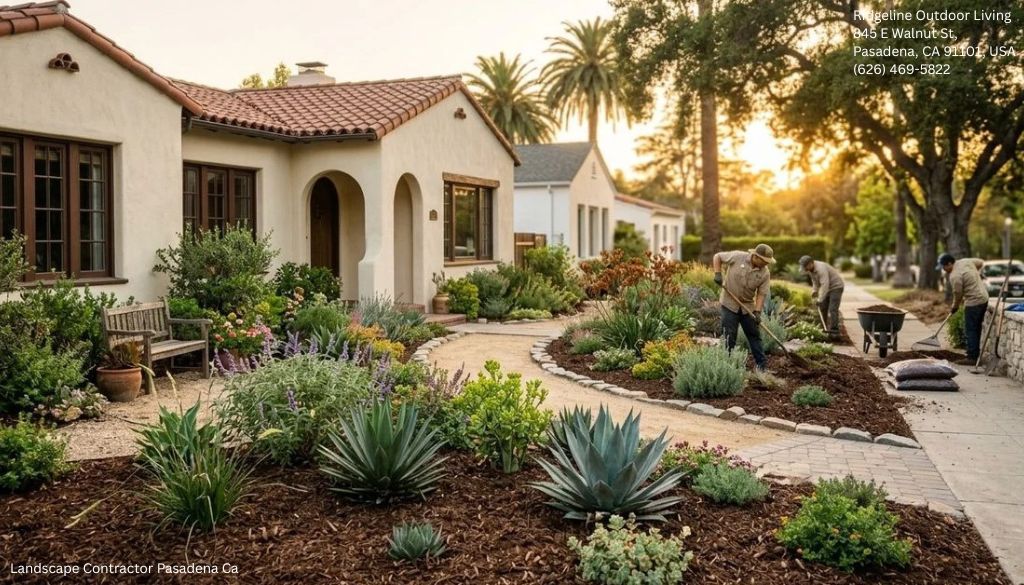
Planting design has similar leverage. Layered canopy, shrub, and groundcover plantings intercept rain, slow it, and send it into the soil. Inorganic mulches like gravel can form visually clean strips along edges where you want fast draining and low maintenance, while organic mulches feed soil in larger beds. Where you are creating a resort-style backyard, balance the lush look with plants that handle both heat and the occasional deluge without collapsing. The ultimate guide to drought-tolerant landscaping for our region is really a guide to resilient landscapes overall.
When to bring in engineering
Not every drainage issue needs a stamped plan, but some do. Tall retaining walls, slopes near structures, and sites with history of movement or cracking benefit from geotechnical input. If we see signs like stuck doors, new diagonal interior cracks, or retaining wall lean, we suggest a soils engineer. Their borings and recommendations inform wall design, back-drain sizing, and surface water controls. It is less glamorous than picking stone, but it is how hillside homes stay safe.
The payoff
Good drainage is not a line item to value-engineer away. It is the subtext of every happy backyard gathering when a storm passes and your patio is ready the next day. It is the unremarkable driveway that lasts twenty years, the turf that dries evenly, and the retaining wall that remains a backdrop rather than a problem. It protects the money you put into outdoor kitchens, lighting, and entertainment features, and it adds the quiet confidence that your property works with the climate, not against it.
If you recognize any of the red flags above, schedule a site assessment. We will bring a level, a hose, and a practiced eye, then translate what we see into a clear plan. Whether your next step is a French drain at the side yard, a regraded swale along the fence, or a complete redesign that ties drainage to new hardscapes and planting, there is a way to make water your ally. In Los Angeles, that is the foundation for every beautiful, functional outdoor space.